Exercising at the office: walking pad or desk pedal ?
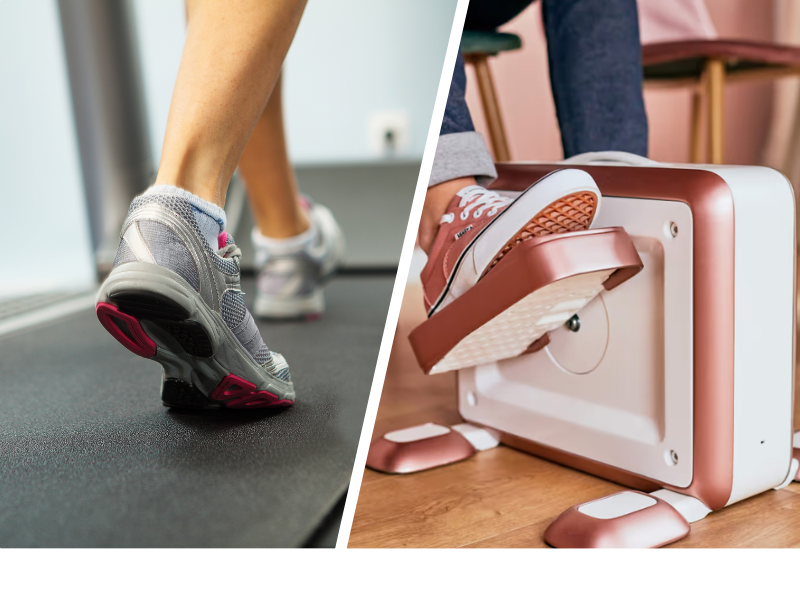 In a world where a sedentary lifestyle has a direct impact on health, concentration, and productivity, it is becoming essential to rethink the way workspaces are organized. Encouraging movement at the office is no longer just a bonus, it is a necessity for the health and engagement of employees. Two solutions are currently popular: walking pad and pedal desk.
In this article, we analyze the main differences between these two approaches to better understand which one promotes both physical activity and professional performance.
Ergonomics:
Walking pad: working while walking involves constant body movement. Even at low speeds, this dynamic makes precise movements difficult: data entry, writing, or intensive reading become more challenging. The body moves while the eyes remain fixed on the screen, which can cause feelings of seasickness and tension in the neck and shoulders. This instability increases the risk of typing errors and therefore frustration, impacting productivity. The treadmill is ideal for online training or passive content, but less suitable for complex tasks requiring concentration and precision.
EVEIA Pedal Desk: the only pedal exerciser designed for workspaces. It allows you to remain seated with your upper body perfectly stable, while activating your glutes, abdominals, lower back, quadriceps, and calves through a smooth and gentle movement. Your hands remain precise, the screen does not move visually, and all tasks, even the most demanding ones, can be performed without any loss of productivity. The pedal exerciser transforms physical activity into an automatic reflex, integrating naturally into your daily work routine.
Workplace Integration:
Walking pad: bulky and heavy, it takes up a significant amount of office space, which can quickly become an obstacle in collaborative or limited-space environments. It also generates vibrations and noticeable noise, which can disturb colleagues in open offices or during video calls. Moving it remains difficult, limiting its flexibility.
EVEIA Pedal Desk: compatible with all chairs, including those with wheels, it easily slides under any desk and can be moved effortlessly as needed, making it ideal for shared use among multiple employees. Quiet and unobtrusive, it integrates seamlessly into the workspace, encouraging teams to use it regularly.
Comfort and Safety:
Walking pad: walking for several hours while focusing on a screen causes significant fatigue. The micro-movements required to stabilize the view strain the eyes and nervous system, leading to visual fatigue and tension. Even minor distractions can cause a loss of balance while walking, posing a safety risk for employees.
EVEIA Pedal Desk: patented, it provides a perfectly adapted pedaling range. The movement engages key muscles without disrupting posture, protects the knees and psoas muscle, while relieving the back and preventing tension associated with sitting. Employees remain comfortably seated, focused, and moving without conscious effort.
A Revolution Against Sedentary Work: EVEIA
The EVEIA Pedal Desk was designed to combine physical activity and productivity in the office without compromise. It offers a natural, discreet, and comfortable movement that can be used effortlessly. Employees can pedal while working, turning every minute at the desk into a health booster. With this pedal desk, physical activity becomes automatic, preserving focus and productivity.
Conclusion
In summary, if the goal is to combine health, comfort, and productivity at the office, the EVEIA Pedal Desk is the natural choice. It provides a discreet, ergonomic solution suitable for all professional tasks, while seamlessly integrating movement into daily work in a safe and simple way. By turning every moment at the desk into an opportunity to move, it helps prevent sedentary-related tension and enhances employee engagement.