8 hours sitting: what is really happening in our body?
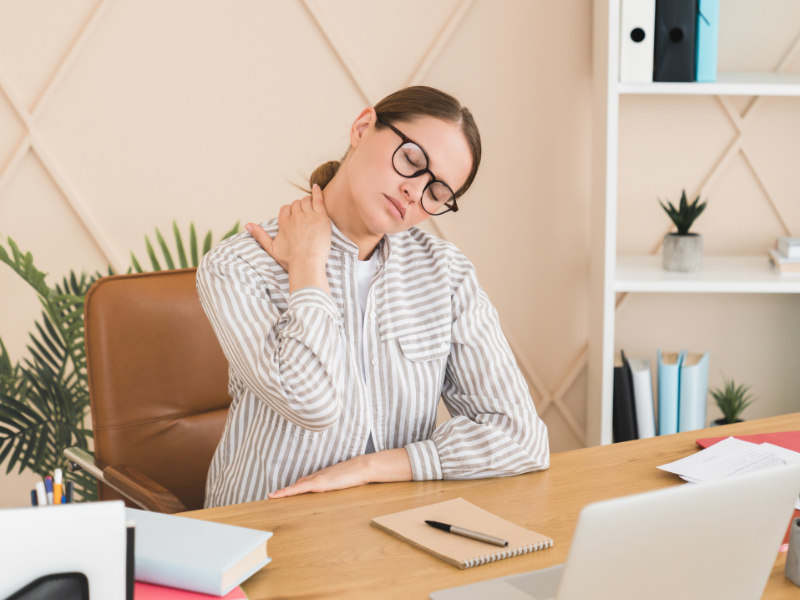
Every day in Switzerland, more than 100,000 employees are absent for health reasons, according to a study by the FOPH. Back pain ranks at the top: video meetings, days spent in front of screens, reduced travel, and back-to-back tasks without real breaks are just some of the causes behind this situation.
The aim of this article is above all to better understand the mechanisms of sedentary behavior and its concrete impacts on the body, in order to identify simple, realistic, and sustainable levers to improve workplace well-being.
A reality that is often misunderstood
Sedentary behavior has a precise definition: it refers to time spent sitting or lying down while awake, with very low energy expenditure.
In other words, a person can be physically active… while still being sedentary. And this is a key point: the issue is not a lack of sport, but excessive inactivity throughout the day. A workout at the end of the day does not necessarily offset several hours of continuous immobility. The effects of prolonged sitting appear during the periods of inactivity themselves, even in people who exercise regularly.
The WHO has integrated this distinction into its recommendations: regular physical activity remains essential, but it is also necessary to reduce sitting time and break up long periods of immobility throughout the day.
What happens in our body:
Within the first 30 minutes
- Leg muscles are less engaged
- Fat digestion processes become less active
- The body shifts from a “consumption” mode to a more “economical” mode
After 1 to 2 hours
- Blood circulation slows, especially in the legs
- Postural muscles essential for spinal support gradually switch off
- Fat metabolism decreases significantly compared to an active position
- Decline in concentration and alertness
After 3 to 4 hours
- The body becomes less efficient at regulating blood sugar after meals
- Energy fluctuations are less well managed
- The back and lower spine are increasingly strained
- First signs of tension may appear: stiffness, discomfort, general fatigue
Beyond 6 to 8 hours
- When sitting extends across an entire day, effects progressively accumulate
- Risk: a stronger impact on overall health
In reality, this threshold is often reached faster than expected: between work, commuting, meals, and evening screen time, many days far exceed 8 hours seated. For a large proportion of employees, this even approaches 10 to 12 hours per day. Surveys estimate that the average working day involves around 12 hours spent sitting. At this level, sedentary behavior is no longer just daily discomfort but becomes a real imbalance factor for the body.
Impact on the body:
Metabolism:
- The body burns about 30% fewer calories than in an active standing position
- Result: over time, more is stored, particularly visceral fat, which accumulates around organs and is the most harmful for health
Blood sugar regulation:
- During prolonged inactivity, post-meal blood glucose remains higher and decreases more slowly
- Over time, this contributes to insulin resistance, a key risk factor for type 2 diabetes
Cardiovascular system:
- The heart and circulation adapt to daily demands; with low movement, blood flows less efficiently
- Over time, this contributes to a higher risk of hypertension and cardiovascular disease
Musculoskeletal system:
- Postural muscles gradually lose efficiency
- Glutes become less active, and the spine tends to collapse forward
- In the long term, this deconditioning leads to pain, stiffness, and postural imbalance
Brain and cognitive functions:
- While movement supports cerebral blood flow and stimulates molecules linked to concentration, prolonged inactivity is associated with reduced alertness, mood disturbances, and increased fatigue
- Indirect effect: persistent physical discomfort can occupy attention, reduce focus capacity, and increase perceived exhaustion
EVEIA: a response to workplace sedentary behavior
It is precisely to address these challenges that Eveia was designed—the only pedal device specifically created for professional environments. Patented, it brings movement back into the core of the working day.
A gentle activity:
- No conscious effort or constraint: employees pedal naturally while working
- Its movement range is adapted for office use, respecting seated posture and joints, enabling comfortable long-term use
- Silent and discreet, it integrates easily into all professional environments, whether open spaces or private offices, without disrupting communication or daily tasks
Concrete benefits:
- Helps reduce tension linked to prolonged sitting
- Improves blood circulation
- Maintains a more stable energy level throughout the day
The movement engages a full muscular chain, particularly the legs, abdominal core, and lower back. Postural support is improved, and natural core stability is strengthened while seated. Concretely, the pedal device helps users sit more upright and reduces strain on the back, contributing to fewer back pains.
Employees also benefit from improved concentration and enhanced overall well-being at work.
Easy integration:
One of the key principles of the device is its simplicity. It can be used with a standard chair, including wheeled office chairs, and fits easily under a desk. Lightweight and portable, it requires no installation. Unlike more restrictive devices such as walking pads, it does not require any change in workplace organization.
An interactive and motivating experience:
An app accompanies the use of Eveia. It allows intensity to be adjusted in one click across five resistance levels. It also tracks activity (time, calories burned, steps), making movement visible and motivating. Individual or team challenges can be introduced to boost engagement and create a positive dynamic within teams.
Benefits for companies:
Increased overall energy:
By promoting continuous light movement throughout the day, teams maintain a more stable energy level. This helps reduce mid-day fatigue and sustain a more consistent workflow.
Improved retention:
A more comfortable work environment enhances employee experience. This directly supports motivation, well-being at work, and long-term talent retention.
Reduced absenteeism:
By limiting the effects of sedentary behavior and associated tensions, companies act on a key risk factor. Over time, this contributes to fewer sick leaves and reduced long-term overload situations.
Competitive advantage:
Integrating a preventive wellness solution positions a company as proactive on workplace health issues. This strengthens employer branding and can become a real differentiator in recruitment.
Conclusion
Sedentary behavior is not immediately visible. Yet its effects are very real. Understanding what happens in the body when sitting for long periods changes the perspective. The issue is not only a lack of physical activity, but above all excessive immobility.
Simple adjustments in work habits can already make a real difference by reintroducing movement where it has gradually disappeared. In this context, solutions like Eveia are emerging as innovative tools.
However, Eveia is not a fitness device. It is designed as an activation tool. The goal is not to do sports at work, but to reduce the effects of immobility by reintroducing movement. This distinction is essential: breaking up sedentary time does not replace the regular physical activity recommended by the WHO—it complements it. The two dimensions are complementary. The challenge is therefore not to do more sport at work, but to rethink the role of movement in daily professional life.